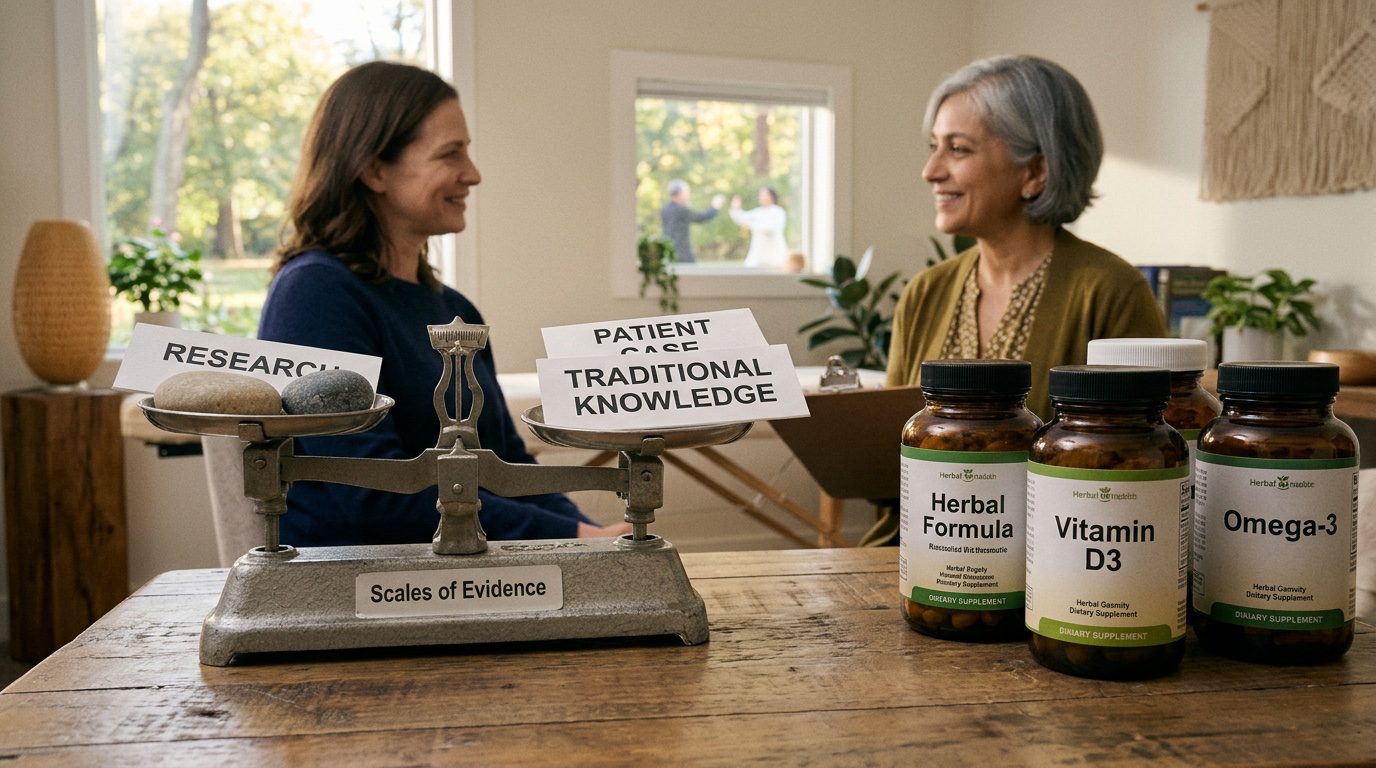
Integrative Medicine: What Actually Works Today
Acupuncture, TENS, tai chi, homeopathy, "energy" diagnostics: an honest look at which drug-free methods hold up in research and which don't.
Thirty years ago, enthusiasts promised that "integrative medicine" would be the medicine of the future. The idea sounded simple: take the best of modern drug-based treatment, add the best of traditional and natural methods, and patients get more help with fewer pills. Some of the papers of that time went much further. They mixed acupuncture and physiotherapy with astrology, "torsion fields" and machines that read disease from the skin before any symptoms appear.
So, three decades later, what has survived real testing, and what has quietly disappeared?
The problem was real
The early integrative movement started from a fair complaint: medicines are not harmless. That part has only been confirmed. A large study of 18,820 hospital admissions found that about 1 in 15 (6.5%) were caused by side effects of drugs. Most of these were predictable, often bleeding from aspirin and anti-inflammatory painkillers.
https://www.bmj.com/content/329/7456/15
The World Health Organization estimates that medication errors cost about 42 billion US dollars a year worldwide. It has launched a global effort to cut severe, avoidable harm from medicines by half.
https://www.who.int/news-room/detail/29-03-2017-who-launches-global-effort-to-halve-medication-related-errors-in-5-years
So the old slogan "if you can avoid prescribing a drug, don't prescribe it" is still good advice. The question is what to offer instead.
What works: movement
The least exotic answer turned out to be the strongest. For osteoarthritis of the knee and hip, the 2019 guideline of the American College of Rheumatology and the Arthritis Foundation strongly recommends exercise, self-management programs, weight loss where needed, and tai chi. A slow martial art from China ended up in the top category of a Western medical guideline.
https://doi.org/10.1002/acr.24131
For back pain, the American College of Physicians advises starting without pills. For a fresh back ache that means heat, massage, acupuncture or spinal manipulation. For long-lasting back pain it means exercise, tai chi, yoga, mindfulness, cognitive behavioral therapy, rehabilitation programs and a few other options. Drugs come second.
https://www.acponline.org/acp-newsroom/american-college-of-physicians-issues-guideline-for-treating-nonradicular-low-back-pain
This is integrative medicine in its most honest form: no mysticism, just evidence that the body responds to regular, sensible movement.
What works, with limits: acupuncture
Acupuncture is the method the early enthusiasts bet on most, and the result is mixed but real. A large analysis of 39 trials with 20,827 patients looked at chronic back and neck pain, shoulder pain, headache and osteoarthritis. Acupuncture worked better than no acupuncture, and the effect lasted at least a year. It also did somewhat better than sham needling, so it is not just placebo. Still, the gap between real and fake acupuncture was small, which means much of the benefit comes from the whole experience of care, not only from the "right points".
https://pmc.ncbi.nlm.nih.gov/articles/PMC5927830
The US National Center for Complementary and Integrative Health sums it up carefully. Acupuncture may help back, neck and knee pain, headaches and pain after surgery. It was no better than sham treatment for irritable bowel syndrome, IVF pregnancy rates and carpal tunnel symptoms. In trained hands with sterile single-use needles it is quite safe, and it should never be a reason to put off seeing a doctor.
https://www.nccih.nih.gov/health/acupuncture
What works, with limits: electricity and light
The old papers were fond of electrical stimulation. One of these methods has held up. TENS is a small device that sends mild electric pulses through the skin. A review of 381 trials with over 24,000 people found that pain is noticeably lower during and right after strong but comfortable TENS than with a fake device. Side effects were mild, mostly skin irritation. The catch: the relief mostly lasts while the device is working.
https://bmjopen.bmj.com/content/12/2/e051073
Low-level laser therapy, now called photobiomodulation, has found one solid place in medicine. International cancer care experts recommend it to prevent painful mouth sores in people getting stem cell transplants or radiation for head and neck cancer.
https://doi.org/10.1007/s00520-019-04890-2
That is a narrow, specific use backed by trials, not the "treats everything" promise of the 1990s.
What did not survive
Homeopathy was part of the integrative package from the start. In 2015, Australia's National Health and Medical Research Council reviewed the evidence. It concluded that there are no health conditions for which there is reliable evidence that homeopathy is effective.
https://www.nhmrc.gov.au/about-us/publications/homeopathy
The "energy" diagnostics did no better: devices that claim to find disease early by measuring skin resistance at acupuncture points. In a double-blind study, such a device could not tell people with allergies from people without them. Its results did not match standard skin tests, and no operator did better than chance.
https://www.bmj.com/content/322/7279/131
Ideas like torsion fields, cosmic energy imbalances and astrology as a medical science were never tested in a way that could prove them right, and they have no place in a modern clinic.
Where integrative medicine stands now
The concept itself did not die. In 2025, the World Health Organization adopted a Global Traditional Medicine Strategy for 2025–2034. Its key words are evidence, safety, regulation, and integration into health systems based on evidence. That is a big shift in tone: traditional methods are welcome, but only after they pass the same tests as everything else.
https://www.who.int/publications/i/item/9789240113176
The honest summary
• Proven and widely recommended: exercise, tai chi, yoga, weight loss, psychological therapies for chronic pain.
• Helps some people, with modest effects: acupuncture for chronic pain, TENS for short-term pain relief, massage, spinal manipulation.
• Works for a narrow purpose: low-level laser to prevent mouth sores during cancer treatment.
• Not supported by evidence: homeopathy, electrodermal "energy" diagnostics, cosmic and torsion theories.
The future the old papers predicted came true only halfway. The drug-free methods that won did not win because they are ancient or natural. They won because someone tested them fairly and they passed. If you want to try any of them, talk to your doctor first, especially if you take regular medicines or have a serious illness. The best integrative care is still care where the treatment fits the person and the evidence fits the treatment.