A Red Dwarf Hurled 32 Trillion Tonnes of Plasma Into Space
Chinese sky cameras caught a small red star in a superflare that threw out a vast cloud of hot gas. What does it mean for planets that could host life?
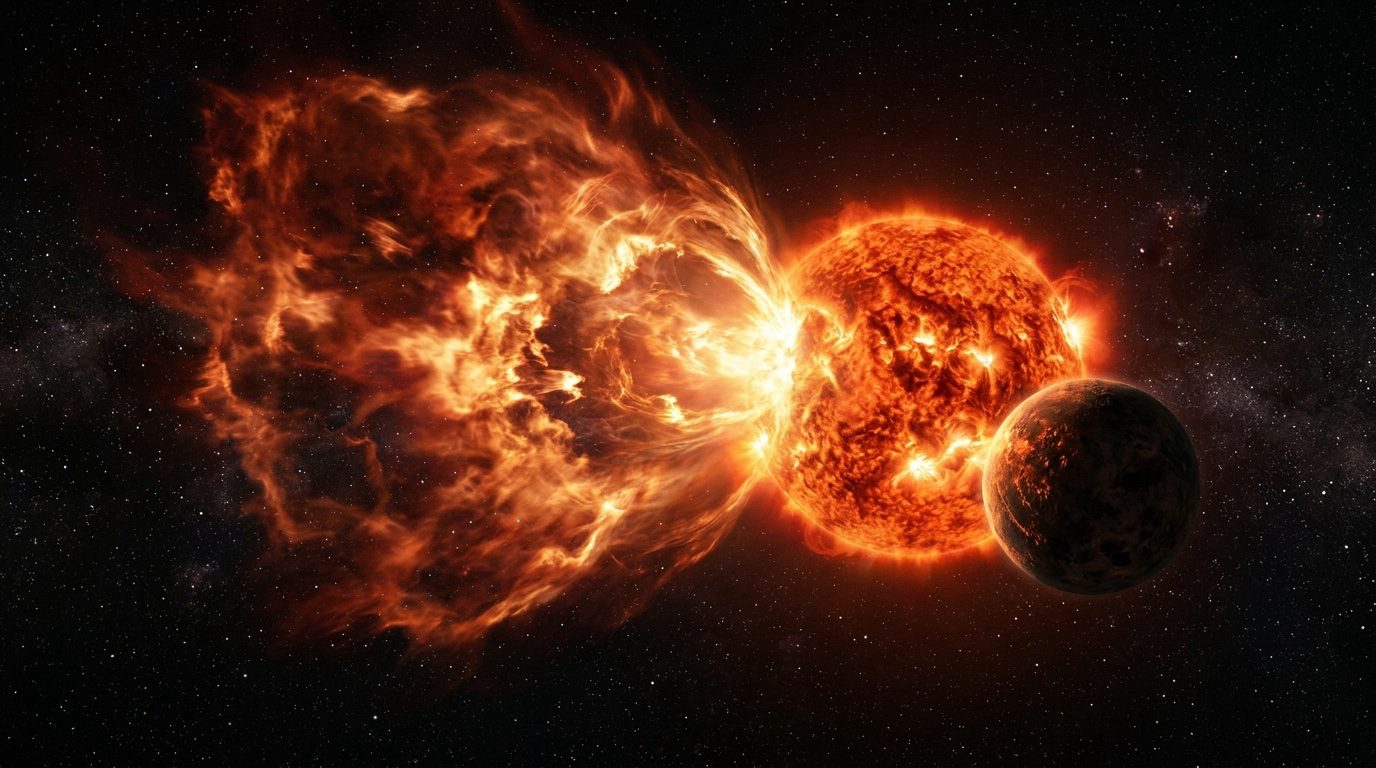
Most of the stars in our galaxy are not like the Sun. They are red dwarfs — small, dim and cool, so faint that not a single one can be seen in the night sky without a telescope. Yet these quiet-looking stars have a temper. On 30 November 2025, one of them, about 280 light-years away, suddenly blazed many times brighter than usual.
The outburst was spotted by GWAC, an array of wide-angle cameras in China that watches large parts of the sky every night, waiting for anything that changes. The event got the name GWAC 251130A. Its energy put it in the class of superflares — eruptions far stronger than anything our Sun usually produces.
Light that gives away motion
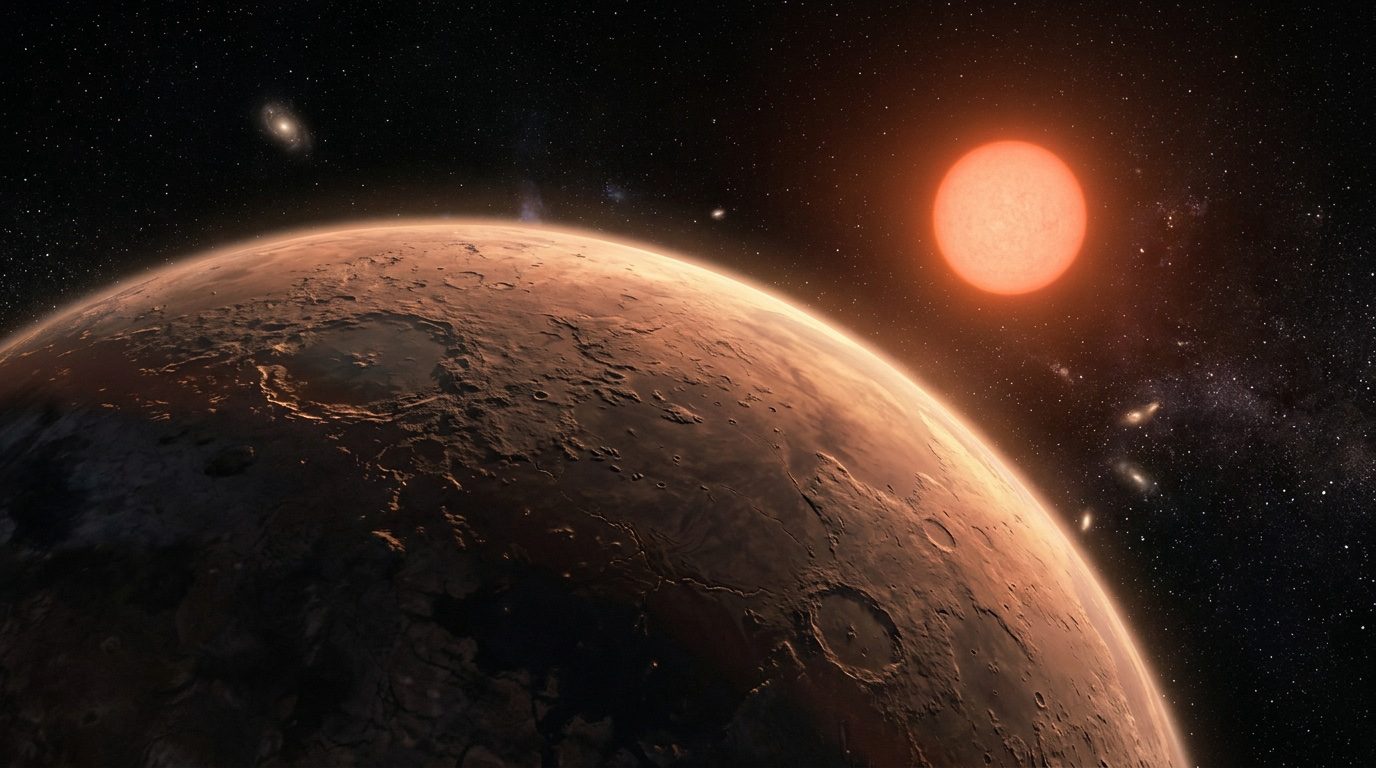
A flash alone does not tell you whether a star has thrown something out. To find out, astronomers spread the star's light into a spectrum, the way a prism makes a rainbow. In it they saw a broad glow of hydrogen pushed toward the blue end. The same effect makes a siren sound higher as an ambulance drives toward you: the colour of light changes when its source is coming closer. Here it meant one thing — a cloud of glowing gas was rushing out of the star, straight in our direction.
The numbers behind the blast
Red dwarfs are the favourite hunting ground for planets that might have life. Because these stars are so dim, a planet has to circle very close to stay warm enough for liquid water. That closeness is also a danger. A world near a restless red dwarf could be struck again and again by bursts of radiation and clouds of charged particles. Over millions of years such storms might strip away its air and water — or perhaps life finds a way to hide from them. Nobody knows yet. Every eruption caught in the act, like this one, is a new clue.
Source: the research paper on arXiv — https://arxiv.org/html/2610.41452v1